When a dancer's hip locks to the precise crack of a doumbek, or when a ney's cry pulls her into a slow, circling taxim, the boundary between body and sound dissolves. This is not accompaniment—this is conversation.
Belly dance—more precisely, raqs sharqi in its Egyptian form, oryantal in Turkish tradition, or any of its regional variants—has always existed in intimate dialogue with its music. The relationship transcends simple meter-matching; it encompasses centuries of melodic evolution, regional identity, and the spontaneous architecture of live performance. To understand this dance, one must listen—and not merely hear.
The Rhythmic Vocabulary: More Than a Beat
Rhythm pulses through belly dance; music doesn't merely accompany—it commands the dancer's every isolation and sweep. Yet the rhythms themselves carry specific meanings, histories, and physical demands that transform abstract timekeeping into embodied narrative.
Consider the maqsoum, that ubiquitous 4/4 pattern whose dum-tek-tek-dum-tek cadence anchors countless Egyptian classics. Its even, walking pace invites grounded hip work—maya figures, gentle drops, the measured confidence of a dancer establishing presence. Contrast this with the saidi, derived from Upper Egyptian folk tradition: its heavy first beat and asymmetrical structure (dum-dum-tek-dum-tek) demands athletic posture, playful fellahi footwork, perhaps even the twirling of a wooden stick in mock combat.
A malfuf rhythm at 180 BPM demands rapid-fire shimmies and traveling steps; the dancer becomes percussion made visible. In contrast, a chiftetelli—that sensual 8/4 cycle beloved of Turkish and Greek traditions—at half that tempo invites liquid torso undulations, each beat stretched across multiple breaths.
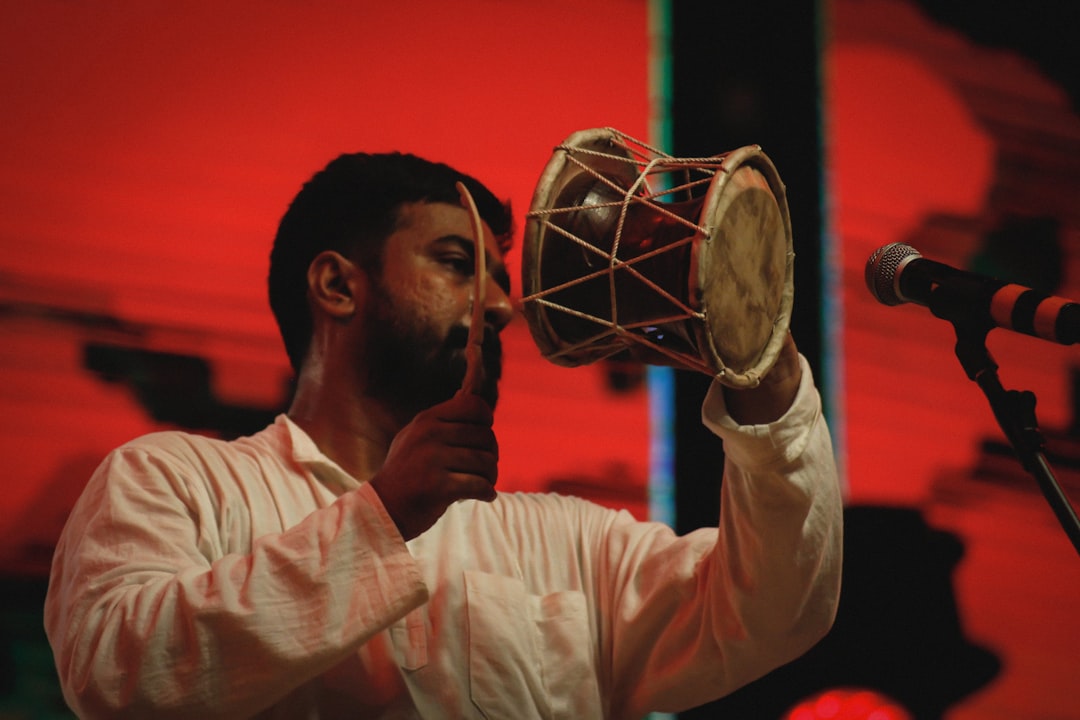
The drummer, traditionally, is not merely timekeeper but co-creator. Masters like Hossam Ramzy or Souhail Kaspar built careers on their ability to read a dancer's energy, to push and pull against expectation, to transform a predictable phrase into spontaneous dialogue. The doumbek's goblet shape—played with fingertips, palms, and the full hand—produces a spectrum of tones: the deep dum resonating through the floor, the sharp tek cutting through air, the muffled ka like a held breath.
Melodic Architecture: The World of Maqam
If rhythm provides the skeleton, melody supplies the emotional nervous system—and here, belly dance music diverges sharply from Western harmonic expectations.
Arabic music operates through maqamat: melodic modes not unlike scales, but infinitely more nuanced. Each maqam carries associated moods, times of day, even therapeutic properties. Rast, with its balanced, dignified character, often opens performances; Hijaz, with its augmented second and unmistakable tension, evokes mystery, longing, the desert at twilight. Bayati, perhaps the most ubiquitous, carries the warmth of everyday speech, the comfort of familiar stories.
The dancer must recognize these modes not intellectually but physically. A taxim—the unmetered, improvisational solo that traditionally introduces or transitions between composed sections—offers no predictable structure. The ney (end-blown flute), oud (fretless lute), or qanun (plucked zither) explores the maqam's emotional terrain, and the dancer must follow, anticipating modulations, responding to microtonal inflections that have no equivalent in Western notation.
This is where technical training meets intuitive listening. The dancer cannot count her way through a taxim; she must breathe with the musician, her body becoming the visible manifestation of melodic contour.
Regional Voices: One Dance, Many Musics
To speak of "belly dance music" as a unified tradition is to erase the very diversity that makes the form vital. The dance's contested origins—Egyptian ghawazi, Turkish çengi, North African shikhat, Romani diaspora traditions—have produced distinct musical ecosystems that continue to evolve.
Egyptian raqs sharqi traditionally emphasizes orchestral grandeur. The golden age of Cairo cinema (roughly 1930s–1960s) established the template: Mohammed Abdel Wahab's sweeping string arrangements, Umm Kulthum's epic vocal poems, the full takht ensemble expanded to symphonic proportions. Even contemporary Egyptian performance retains this preference for lush, composed pieces with clear structural markers.
Turkish oryantal, by contrast, favors the raw energy of fasil ensembles: clarinet, violin, kanun, and the penetrating zurna (double-reed pipe) in folk-influenced settings. The Romani