If you think architecture is just about buildings, you haven't met Dele Adeyemo. A recent piece on ArchDaily dives into the work of this Nigerian architect and spatial practitioner, and it’s a perspective that feels urgently relevant, not just for Lagos, but for cities everywhere.
Adeyemo doesn't see empty plots or concrete shells. He sees a stage. His practice, rooted in the Yoruba concept of *Aṣẹ* (the power to make things happen), treats urban space as a living, breathing entity shaped by movement, ritual, and collective energy. He’s less interested in the static monument and more in the *event*—the street procession, the spontaneous gathering, the daily dance of survival and celebration.
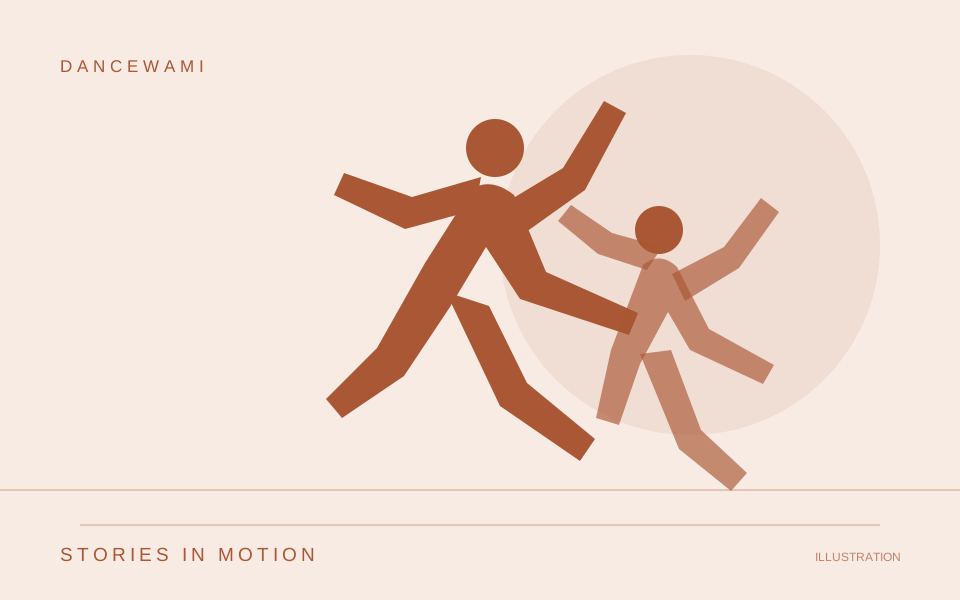
This is where it gets fascinating for anyone who cares about dance and culture. Adeyemo argues that the choreography of bodies in space—the way people navigate, congregate, and move through a market, a bus stop, or a waterfront—is the **true architecture** of a city like Lagos. The formal buildings are just the backdrop. The real design is happening in the kinetic, social patterns of its inhabitants.
He talks about "cosmological practices" not as abstract folklore, but as active, spatial technologies. A festival isn't just a cultural event; it's a temporary re-mapping of urban territory, claiming space, rewriting routes, and asserting a communal identity. This reframes dance from performance to a **form of urban planning**. It’s a powerful idea: the collective body, moving with purpose, as the primary city-shaping force.
So, why should this matter to us, now?
In a world where global cities risk looking homogenized—all glass towers and sterile plazas—Adeyemo’s work is a masterclass in place-making rooted in specific cultural rhythm. It challenges planners and architects to listen to the city's existing choreography before drawing a single line. How do people *actually* move here? What rituals define this space? How can design amplify, rather than stifle, that energy?
For dancers and choreographers, it’s an invitation to see your work as inherently architectural. Your movements don't just happen *in* a space; they dialogue with it, define it, and temporarily claim it. You are, in a very real sense, building with your body.
Adeyemo is choreographing Lagos by first learning its existing dance. The lesson for all of us is profound: the most resilient, vibrant, and human cities may not be the ones with the flashiest skylines, but the ones whose design hums to the rhythm of the people who live there. The future of urban life might just depend on learning the steps.