---
It started over a glass of wine
Giovanni Rossi was arguing about risotto. Not the texture, not the rice—that argument had been settled centuries ago. No, he was insisting that a really good risotto should move. By the time Isabella Moretti stopped laughing, they'd been talking for three hours and missed the dinner rush entirely.
That conversation, somewhere between a professional debate and a first date, became The Playlist.
Most fusion restaurants give you a gimmick. A DJ spinning while you eat, maybe some LED hula hoops between courses. But The Playlist operates on a different principle: what if the food and the movement weren't side by side, but actually talking to each other?
How it actually works
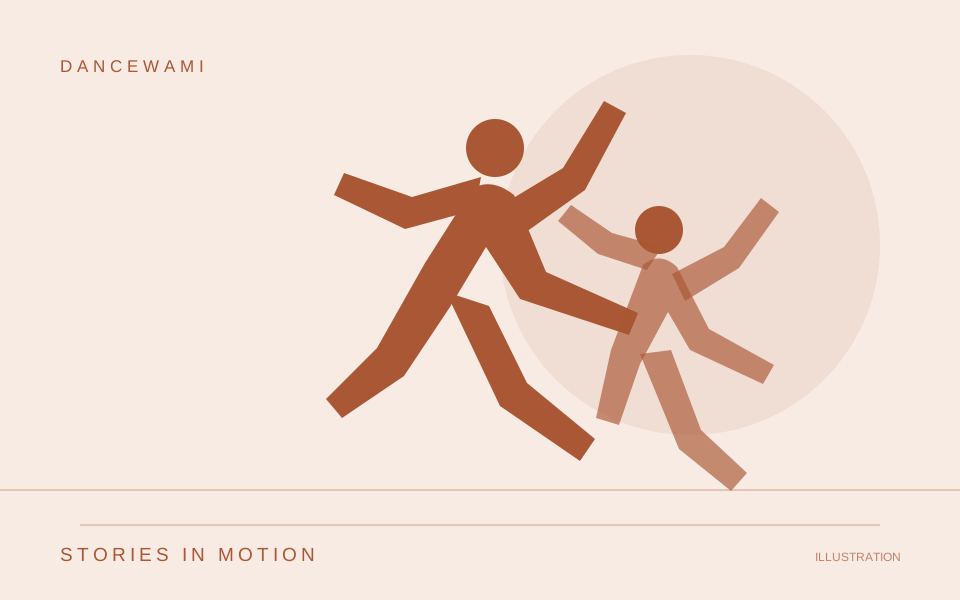
When Isabella designs a performance, she doesn't just watch Giovanni cook. She tastes everything first. The squid ink risotto goes black and heavy on the plate? Then the dancer's movement slows, grounds, drops low. The lemon zest catches the light? That same dancer breaks into something sharper, quicker—three or four quick spins that scatter like zest across the stage.
It sounds conceptual, but in practice, it's surprisingly visceral. I watched a couple at the corner table during a Saturday service. They weren't looking at their plates. They were looking at the dancer gliding between tables, her arms extended like she was cradling something invisible, and I saw the woman at the table physically lean back as the dancer passed. That was when I understood what Giovanni meant about risotto that moves.
The dishes aren't the point
Well, they are. But they're not only the point.
Giovanni trained in Bologna. No fusion chef nonsense—his Margherita is a Margherita, his cacio e pepe is strict Roman tradition. What he's added is a choreography note in his head. "I know Isabella will be doing something with the pasta," he told me, twirling a fork absently during prep. "So I time the finishing. Thirty seconds early, and the cheese hasn't set. Thirty seconds late, and I've missed the moment."
The moment. That's what this place is selling, really. Not Italian food, not dance. The moment where the fork hits your mouth and the dancer hits her mark, and for one second your brain can't tell which sense to prioritize.
What nobody tells you about the intimacy
Restaurants this ambitious usually feel cold. All that art, all that intention—it's easy for the diner to become an audience member instead of a participant. The Playlist has maybe twenty tables. No two are the same distance from the floor.
Isabella picks the seating arrangement based on the evening's choreography. A couple celebrating an anniversary might get the spot where the tango dancer can reach across the gap between tables. A group of friends might get the corner where a contemporary piece unfolds at arm's length—close enough to feel the breath.
"We had one guy cry during the finale," Giovanni said. "Not sad crying. He said it was like realizing he was inside the music. That happens when you're close enough."
You should probably just go
Forget what I said about philosophy. Forget the chef-choreographer origin story. The real reason to visit is simpler than that: The Playlist makes you feel something.
You're not reading about Italian cuisine. You're not watching dance from a safe distance. You're eating pasta that's been designed to respond to a performance, and you're watching movement that's been shaped by the weight and texture of what you taste. By the second course, you stop thinking about the concept. By the third, you're just there—fork in hand, eyes following a dancer who's somehow speaking the same language as your tiramisu.
That's not a restaurant review. That's an experience that somehow works, and works beautifully, and I'm still not entirely sure how they pulled it off. But I'm definitely going back.